Nutrients men lack: the US and UK compared with Japan and other countries
The studies and sources we used are listed at the end. Editorial policy
Every country's diet leaves its own gaps. A 2024 global study estimated, country by country, how many men fall short of 15 vitamins and minerals from food alone. Here is where men in the US and UK stand, how that compares with Japan and others, and what to eat.
Model estimates from a 2024 global study (Passarelli et al., Lancet Global Health) put vitamin E, vitamin C and magnesium at the top of US men's shortfalls, and vitamin E, vitamin A and iron at the top for UK men. Japan's list is different (vitamin B6, magnesium, zinc), and calcium shortfalls are far more common in Japan, China and South Korea than in the US. Compared within the same country and age group, men more often fell short than the rest of the population on magnesium, zinc, vitamins C, A and B6, thiamin and niacin. These are estimates from food only, best read as rankings rather than exact percentages.
Contents
- US and UK men: where the model sees gaps
- Japan as a cross-check: what a national survey measured
- Younger men fell shorter in Japan's survey
- How countries compare
- Nutrients men fall short on more often
- Read the numbers with care
- Why modern diets fall short
- What to eat
- If you want to check your everyday meals
- When to see a doctor
- FAQ
- References
- Keep reading
US and UK men: where the model sees gaps
- Method
- Estimated the spread of intakes in each country from 2018 diet data, then the share of people below international requirements. For many countries the shape of the spread is borrowed from a similar country
- Found
- Worldwide, iodine, vitamin E, calcium and iron were each estimated to fall short in more than 6 in 10 people
- Caveat
- Food only: fortified foods and supplements are not included, so it can differ from national surveys
From the study's published data, here is the estimated share of men aged 20 and over falling short in the US, the UK and Japan, for the nutrients that rank high in at least one of them.
| Nutrient | US | UK | Japan |
|---|---|---|---|
| Vitamin E | 88% | >99% | 43% |
| Vitamin C | 63% | 57% | 76% |
| Magnesium | 54% | 55% | 98% |
| Vitamin A | 34% | 97% | 74% |
| Calcium | 22% | 40% | 72% |
| Zinc | 22% | 39% | 95% |
| Iron (weak signal for men) | 37% | 91% | 87% |
Model estimates for 2018 from Passarelli et al. (2024), men aged 20 and over, age groups weighted by population. Bold: the country's top three (iodine, selenium and vitamin D excluded; see "Read the numbers with care").
- Vitamin E tops both lists. Among the 70 countries we pulled from the data, the UK ranked 3rd highest for vitamin E and the US 15th. Vitamin E comes mainly from nuts, seeds and vegetable oils.
- US men: vitamin C and magnesium next. Both come mostly from fruit, vegetables, beans, nuts and whole grains.
- UK men: vitamin A ranked 2nd highest of the 70 countries. The iron figure is less reliable for men (see below).
Japan as a cross-check: what a national survey measured
Models can be checked against countries that measure intake directly. Japan's 2019 National Health and Nutrition Survey compared with Japan's 2025 recommendations for men:
| Nutrient | Men 20+, average | Japan's recommendation, and the gap |
|---|---|---|
| Calcium | about 500 mg | 750–800 mg about 250–300 mg short |
| Magnesium | 270 mg | 330–380 mg about 60–110 mg short |
| Vitamin D | 7.9 µg | 9.0 µg (adequate intake) about 1 µg short |
| Zinc | 9.2 mg | 9.0–9.5 mg about level on average |
| Iron | 8.3 mg | 6.5–7.5 mg met on average |
A day. Japan's recommendations vary by age; they are not the same as US or UK values.
The survey agrees with the model on magnesium. But it puts Japanese men's zinc at the recommended level, while the model estimates 95% short: the diet data behind the model show much lower intakes than Japan's own survey. So Japan's very high model figures for magnesium, zinc and vitamin B6 are probably overstated. The same kind of gap could exist for any country, which is why the rankings are more useful than the exact numbers.
Younger men fell shorter in Japan's survey
| Japanese men | Calcium | Magnesium | Vitamin D |
|---|---|---|---|
| 20s | 462 mg | 227 mg | 5.9 µg |
| 30s | 395 mg | 236 mg | 5.5 µg |
| 40s | 442 mg | 251 mg | 6.4 µg |
| 50s | 471 mg | 265 mg | 6.8 µg |
| 60s | 533 mg | 286 mg | 7.9 µg |
| 70s | 585 mg | 298 mg | 10.9 µg |
Average a day, Japan's 2019 National Health and Nutrition Survey (Table 1-2).
Men in their 30s averaged about half of Japan's calcium recommendation, and men in their 20s and 30s were more than 100 mg short on magnesium. The survey does not say why, and we have no comparable age breakdown here for the US or UK. Being young does not mean your diet is complete.
How countries compare
The top three shortfalls for men aged 20 and over, from the same model estimates:
| Country | Top three shortfalls (highest first) |
|---|---|
| United States | Vitamin E, vitamin C, magnesium |
| United Kingdom | Vitamin E, vitamin A, iron |
| Ireland | Vitamin E, iron, vitamin A |
| Japan | Vitamin B6, magnesium, zinc |
| China | Vitamin E, calcium, vitamin A |
| South Korea | Vitamin E, vitamin C, iron |
| Germany | Folate, iron, vitamin E |
| France | Folate, vitamin A, vitamin C |
| Spain | Vitamin E, vitamin C, magnesium |
| Italy | Vitamin E, folate, magnesium |
| India | Folate, riboflavin (B2), zinc |
Passarelli et al. (2024) published data, 2018 estimates, men 20+, population-weighted. Iodine, selenium and vitamin D excluded.
- Vitamin E is in the top three in most of the countries in the table (the US, the UK, Ireland, Germany, Spain, Italy, China and South Korea), but not in Japan, France or India.
- Calcium splits East and West: about 7 in 10 men were estimated short in Japan, China and South Korea, against about 2 in 10 in the US and fewer in Germany and France. Lower dairy intake is a likely reason.
- Magnesium appears in the top three for the US, Spain, Italy and Japan. In Japan, the national survey points the same way.
Nutrients men fall short on more often
The study also compared the sexes. Compared within the same country and age group, men more often fell short than the rest of the population on seven nutrients:
- Magnesium
- Zinc
- Vitamin C
- Vitamin A
- Vitamin B6
- Thiamin (vitamin B1)
- Niacin (vitamin B3)
Worldwide, about 49% of adult men were estimated to fall short on magnesium, against 29% of the rest of the adult population, and 56% on zinc against 45%. The model does not explain why, but magnesium and zinc are worth keeping in mind when you look at your own meals.
Read the numbers with care
The country figures are model estimates based on food alone. Fortified foods (such as iodized salt or fortified flour and milk) and supplements are left out, so countries where these are common look worse than they are. Parts of the calculation borrow data from similar countries, and results can differ from each country's own surveys, as Japan shows. Read them as "which nutrients rank high in a country" and "which country is higher", not as exact percentages. We left out iodine and selenium because the published data do not match the paper's own totals, and vitamin D because the model ignores what the skin makes in sunlight. Iron requirements for men are set high in the model, so treat iron for men as a weak signal.
Why modern diets fall short
The nutrients at the top of the US and UK lists come mainly from foods that a diet of refined grains, processed food and takeaways tends to crowd out:
- Vitamin E: nuts, seeds and vegetable oils.
- Vitamin C: fruit and vegetables.
- Magnesium: seeds, nuts, beans, leafy greens and whole grains. Refining strips most of it from grains: in Japan's food tables, cooked brown rice has about 7 times the magnesium of white rice.
- Vitamin A: liver, eggs and dairy, and orange and dark green vegetables.
More on magnesium in magnesium deficiency in men, and on sun and fish in vitamin D deficiency in men.
What to eat
Easy sources of each, all found in an ordinary supermarket:
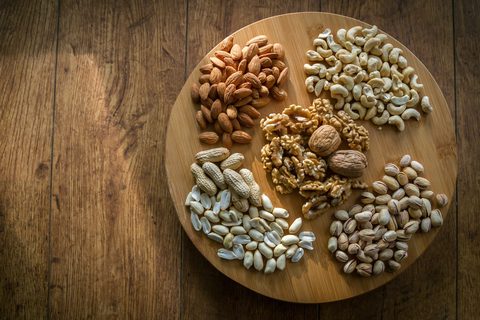
- Vitamin E: almonds, sunflower seeds, peanuts and peanut butter, and cooking with vegetable oils.
- Vitamin C: citrus fruit, kiwi, berries, peppers and broccoli.
- Magnesium: pumpkin seeds (about 156 mg per ounce), almonds (about 80 mg per ounce), spinach (about 78 mg per half cup, boiled), black beans (about 60 mg per half cup) and whole grains.
- Calcium: milk, yogurt and cheese, fortified plant milks, and canned fish eaten with the bones.
- Vitamin D: oily fish such as salmon (about 14 µg per 3 oz, close to the US RDA of 15 µg) and fortified milk or cereal.
A handful of nuts or seeds and an extra portion of vegetables or fruit a day covers several of these at once. For foods linked to erections in research, see foods and erectile function.
If you want to check your everyday meals
National averages do not tell you which nutrients your own meals are low in; only a record does. Adding up every meal is hard work, so photographing meals and looking at the pattern over one or two weeks is easier to keep up.
Estimates from a photo are rough, not exact amounts.
When to see a doctor
Changing your diet is for men who feel well. See a doctor rather than trying food or supplements first if:
- tiredness or poor appetite lasts more than 2 weeks, or you lose weight without trying: something other than nutrition may be behind it.
- you get palpitations or breathlessness, or people say you look pale: a blood test can check for anemia.
- bone or back pain keeps going, or you broke a bone in a minor fall.
- you take a supplement and have ongoing nausea, diarrhea or thirst: stop it and see your doctor.
- you have blood in your urine, pain when urinating, a fever, or erections suddenly became harder: see a urologist or your doctor.
FAQ
Which nutrients are men in the US and UK most often short of?
In model estimates from a 2024 global study, the top three for US men were vitamin E, vitamin C and magnesium, and for UK men vitamin E, vitamin A and iron (the iron figure for men is a weak signal). These are estimates from food intake only, not measurements.
Do American or British diets fall shorter than Japanese ones?
Neither comes out simply better. In the same estimates, calcium shortfalls were much more common in Japan, China and South Korea than in the US, while vitamin E was near the top for the US and UK but not for Japan. Each country has its own set of gaps.
Do younger men fall shorter?
In Japan's national survey, men in their 20s to 40s had the lowest average intakes of calcium, magnesium and vitamin D, and men in their 60s and 70s the highest. The survey does not explain why, and the same pattern has not been checked here for the US or UK.
Will a multivitamin cover all of it?
It can fill some gaps, but several nutrients have an upper limit, and stacking products can push you over it without noticing. Look first at which nutrients your meals are low in, and check the amounts if you use a supplement. If you have kidney disease or take medicines, ask your doctor or pharmacist first.
References
- Passarelli S, Free CM, Shepon A, Beal T, Batis C, Golden CD. Global estimation of dietary micronutrient inadequacies: a modelling analysis. Lancet Glob Health. 2024;12(10):e1590-e1599. pubmed.ncbi.nlm.nih.gov/39218000/
- Passarelli S, et al. Country, age and sex estimates (2018) from the study above: the authors' data repository. github.com/cfree14/global_intake_inadequacies
- Harvard Gazette. Billions worldwide deficient in essential micronutrients. 29 August 2024. news.harvard.edu/gazette/story/2024/08/billions-worldwide-de
- Ministry of Health, Labour and Welfare (Japan). National Health and Nutrition Survey 2019, Part 1, Table 1-2 (men, by age group). In Japanese. www.mhlw.go.jp/content/000711006.pdf
- Health and Longevity Net (Japan Foundation for Aging and Health). Magnesium: functions and daily intake, based on the Dietary Reference Intakes for Japanese (2025). In Japanese. www.tyojyu.or.jp/net/kenkou-tyoju/eiyouso/mineral-mg.html
- NIH Office of Dietary Supplements. Magnesium: Fact Sheet for Health Professionals. ods.od.nih.gov/factsheets/Magnesium-HealthProfessional/
- NIH Office of Dietary Supplements. Vitamin D: Fact Sheet for Health Professionals. ods.od.nih.gov/factsheets/VitaminD-HealthProfessional/